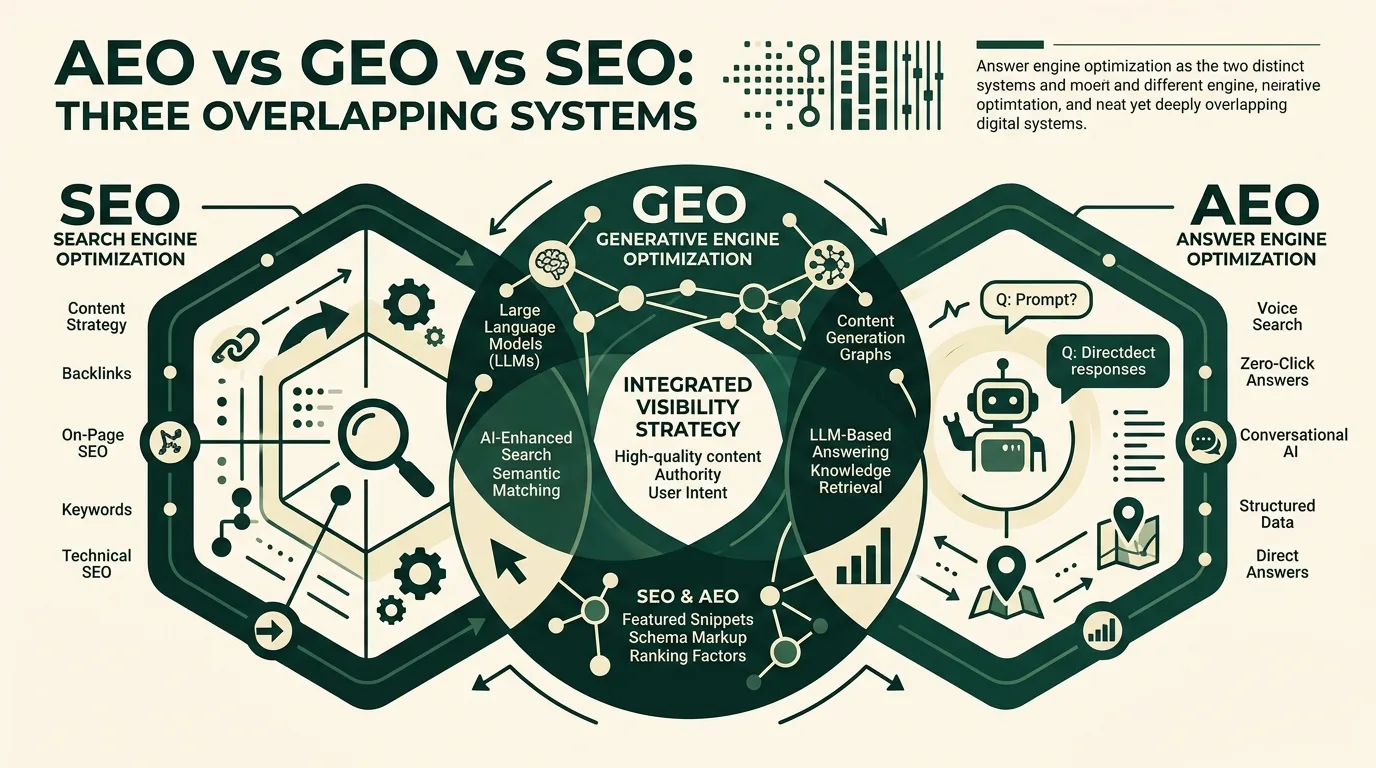
SEO, AEO, and GEO are increasingly presented as separate disciplines. That framing is useful only up to a point. It can help teams notice new discovery behaviors, but it can also create three repetitive content programmes competing for the same pages.
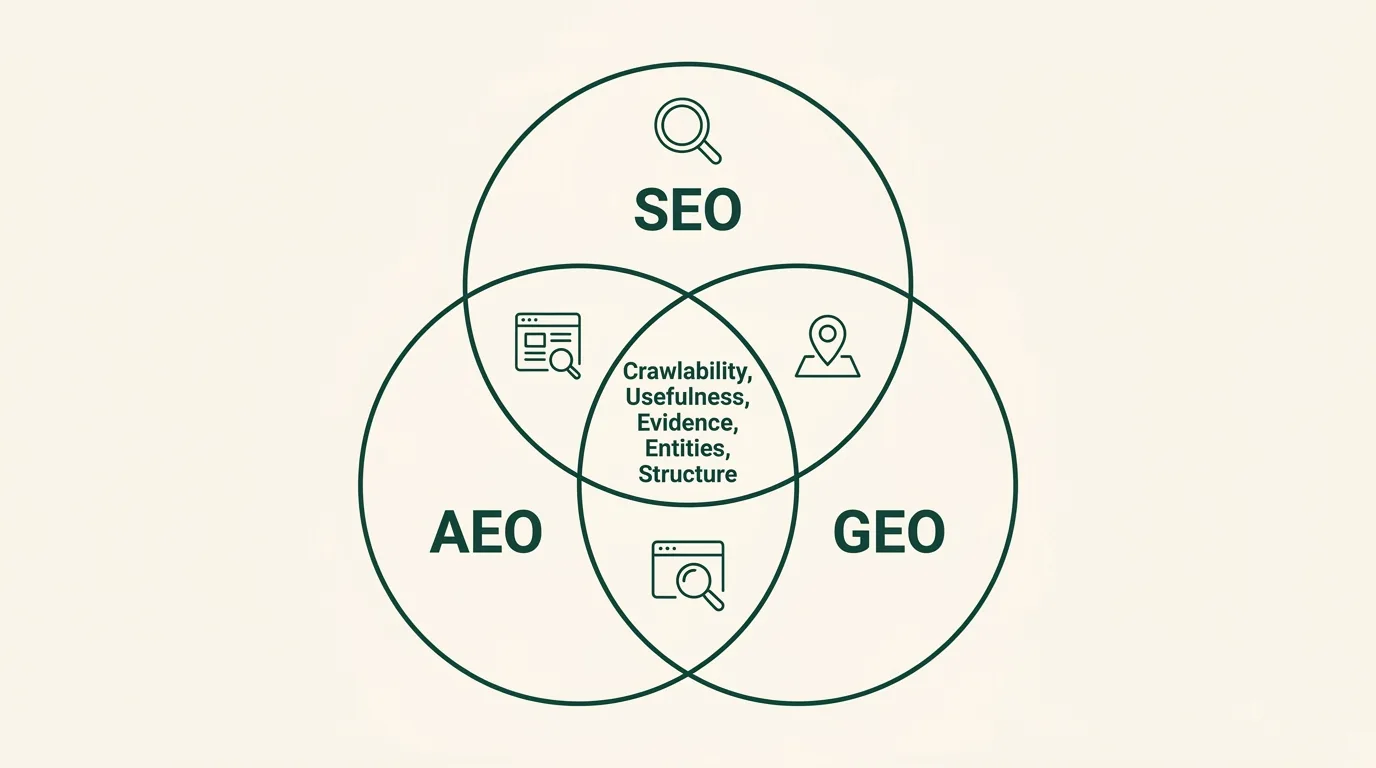
The practical approach is one discovery system with shared foundations and different emphasis by experience.
What SEO means in 2026
Search engine optimization improves a site’s eligibility, relevance, authority, and usefulness for organic search. It includes crawlability, indexation, information architecture, page experience, content, internal linking, structured data, and authority signals.
SEO is not only blue-link ranking. Google’s generative search features use the same underlying requirement that pages be indexed and eligible to appear with snippets. Strong SEO services remain the foundation.
What AEO means
Answer engine optimization improves how clearly content answers specific questions in systems that provide direct responses. It emphasizes concise definitions, question-led structure, entities, supporting context, and technically accessible content.
AEO does not mean turning every heading into a question or adding a giant FAQ. The content should remain natural and useful. Review Microdigm’s AEO services for implementation support.
What GEO means
Generative engine optimization focuses on how content and entities are discovered, interpreted, selected, cited, and represented in generative answers. It emphasizes source credibility, factual support, entity consistency, original information, clear relationships, and content freshness.
GEO is not a guarantee of citation. Different systems use different indexes, retrieval methods, models, and interfaces. Measurement should state those limits.
What does not change
Across all three, the business still needs:
- Crawlable, indexable canonical pages
- Clear information architecture and internal links
- Content that satisfies a real user need
- Visible text for important information
- Accurate titles, headings, and entity details
- Real authorship and editorial accountability
- Evidence for claims
- Useful images and video where appropriate
- Structured data that matches visible content
- Ongoing updates when facts or customer needs change
Google explicitly says there are no additional technical requirements or special schema needed for AI Overviews and AI Mode. Its 2026 generative optimization guide reinforces helpful content, technical clarity, and relevant media.
What changes in practice
1. Queries become conversations
People ask longer, conditional, and comparative questions. Content should cover the decision and its important subquestions without generating a separate thin page for every wording.
2. Citation becomes a visibility outcome
The user may receive an answer before visiting a site. Brands should measure references and qualified downstream behavior where data exists. Bing’s AI Performance reporting is one example.
3. Entity consistency matters more visibly
Organization names, services, people, locations, and claims should remain consistent across the website and credible external profiles. Ambiguity makes accurate representation harder.
Expert interviews, original frameworks, proprietary data, transparent methods, and useful tools give systems and people reasons to reference the source.
5. Content formats work together
Text, images, video, and structured data should describe the same facts and relationships. A useful visual can appear in search and generative experiences, but it should not contain unverifiable claims.
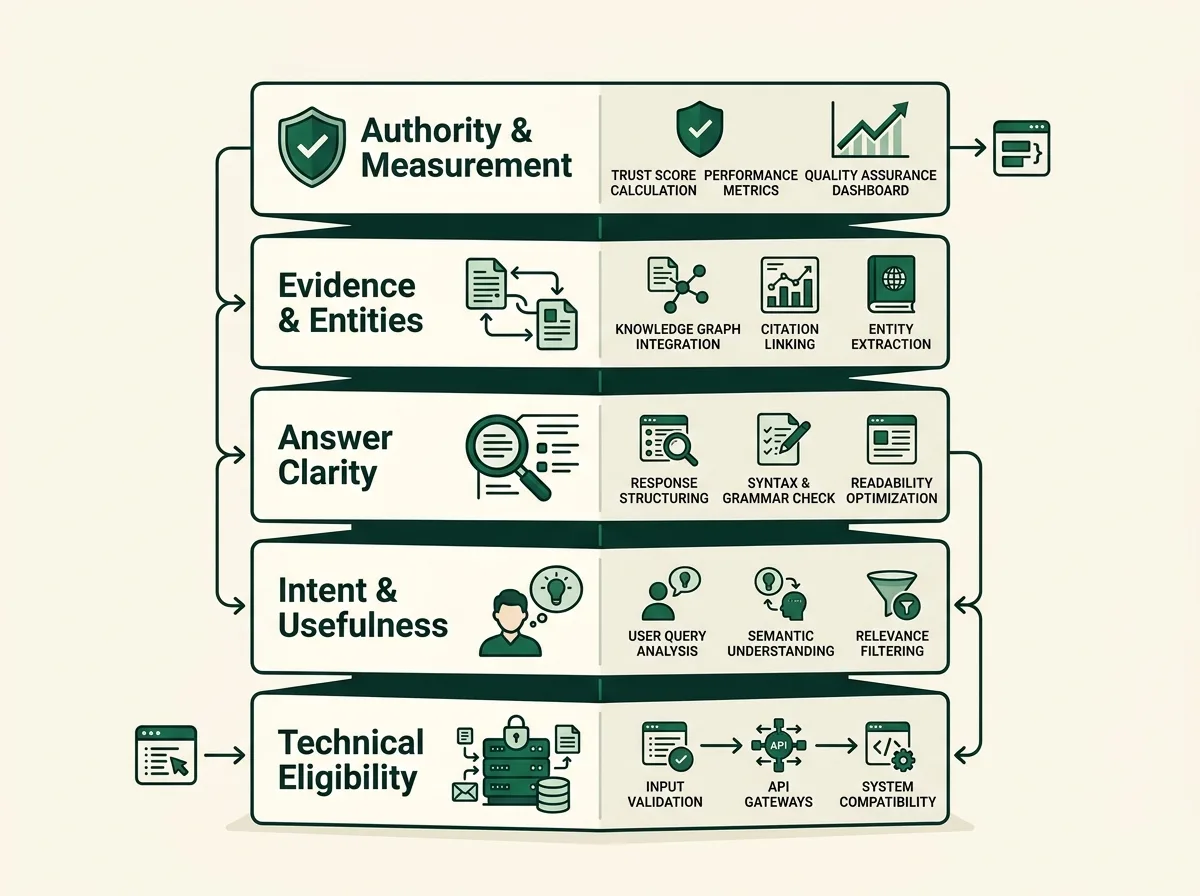
One operating framework
Foundation: technical eligibility
Audit crawlability, indexation, canonicals, sitemaps, rendering, page experience, internal links, and visible text. Use the digital audit checklist.
Layer 1: intent and usefulness
Map the customer question, decision, and next step. Build content around the customer journey, not a keyword list alone.
Layer 2: answer clarity
Lead with direct answers where appropriate. Add definitions, comparisons, steps, examples, and limitations. Keep the writing natural.
Layer 3: evidence and entities
Identify the organization, author, subject, service, location, and relationships consistently. Support changeable claims with primary sources and original evidence.
Layer 4: distribution and authority
Earn relevant mentions, links, reviews, partnerships, and expert recognition. Do not treat schema as a substitute for reputation.
Layer 5: measurement and learning
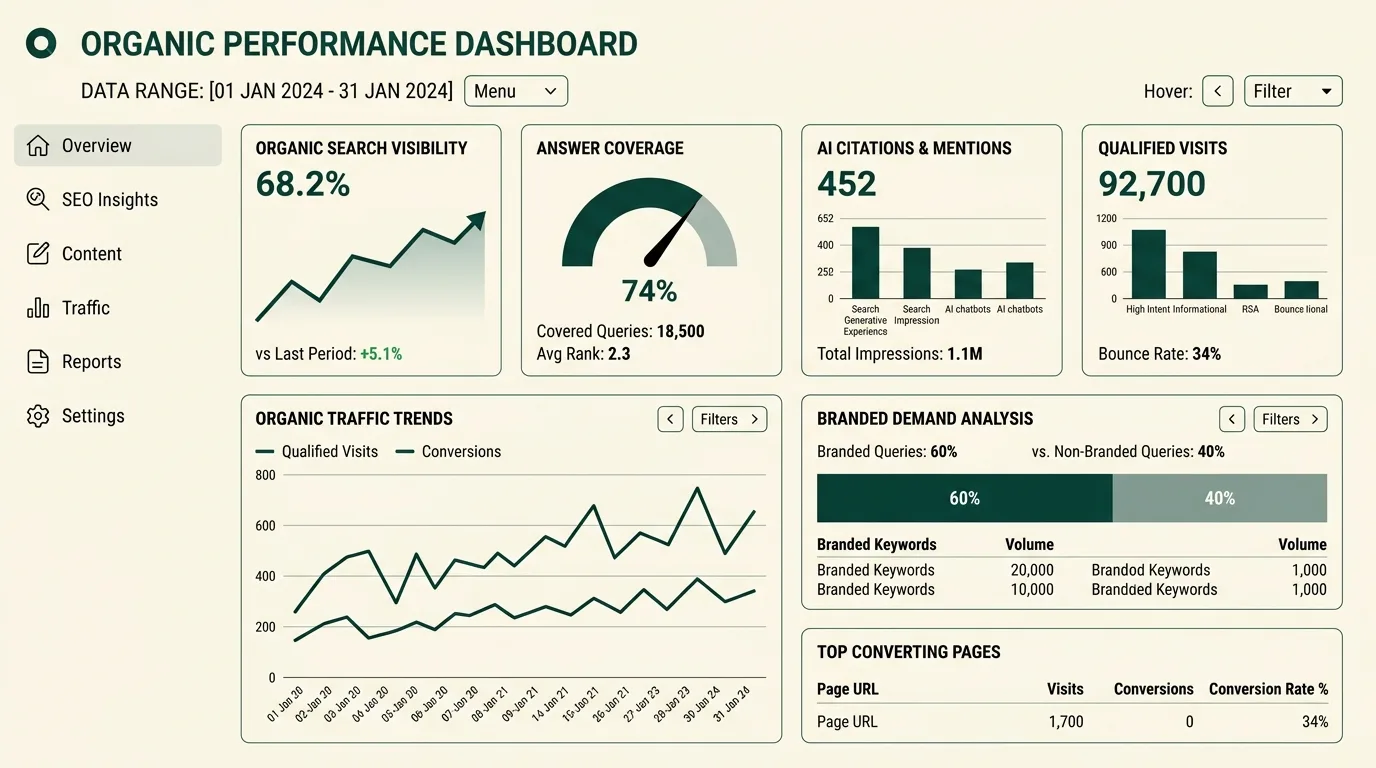
Track search visibility, qualified traffic, conversions, brand demand, backlinks, sales use, and AI citations where available. Use the marketing measurement framework.
Schema recommendations
Use BlogPosting, BreadcrumbList, Organization, Person, and relevant service or business types when they accurately describe visible content. Validate markup and keep dates truthful.
Do not create fake review markup, mark hidden FAQs, or add unsupported properties. Google limits FAQ rich results largely to authoritative government and health sites, and HowTo rich results have been removed. Schema supports understanding; it does not purchase visibility.
Measurement without hype
Google includes AI-feature traffic within Search Console web reporting rather than providing a dedicated AI Overview filter. Bing introduced AI Performance reporting for citations across supported Microsoft experiences. Third-party tools can offer directional estimates, but their coverage and methodology vary.
Track outcomes by URL and topic. When a page earns citations but no qualified behavior, examine whether it answers an early-stage question, lacks a next step, or is being represented for an irrelevant context.
Common mistakes
- Creating three versions of the same article for SEO, AEO, and GEO
- Claiming guaranteed AI citations
- Adding special markup that no platform requires
- Publishing AI-generated pages without expert value
- Treating a concise answer as the entire article
- Ignoring internal links and crawlability
- Measuring visibility without business relevance
Frequently asked questions
Does GEO replace SEO?
No. GEO depends heavily on the same crawlable, indexable, useful web foundation that SEO builds. It adds emphasis on generative representation, evidence, and citation.
Is AEO only for voice search?
No. AEO applies to many answer-led experiences, including search features and AI assistants. Voice is one interface, not the complete discipline.
Is there special schema for AI search?
No special AI schema is required by Google for generative search visibility. Use accurate, supported schema types that match visible content.
Build one discovery system
Explore Microdigm’s SEO services, AI SEO services, and AEO services, or request an AI discovery audit.
Editorial sources
Use these primary or authoritative sources to verify changeable claims before publication. They are editorial references, not a substitute for Microdigm’s own expert review.